Obedience and Redemption

In studying the Word of God, I am drawn to a formal translation, more specifically, I enjoy reading the King James Version, as much of it is written in a manner which my mind thinks and processes concepts of life. I have heard from some that the “thee,” “thou,” “hast,” and other terms simply bring confusion, yet this is how much of my thoughts have been expressed since I started writing for release of thought decades ago. Those who have expressed their dislike for such writings have also expressed the need to read a functional translation, a few utilizing New Literal Translation or the New International Version, I do not fault anyone on their chosen Bible translation, however, I do questions some of the variances that may be present. For instance, if one were to read Acts 8:26-39 in the KJV and then compared to NIV, there would be both similarities and difference, although they may not be significant to some, there are differences, nonetheless.
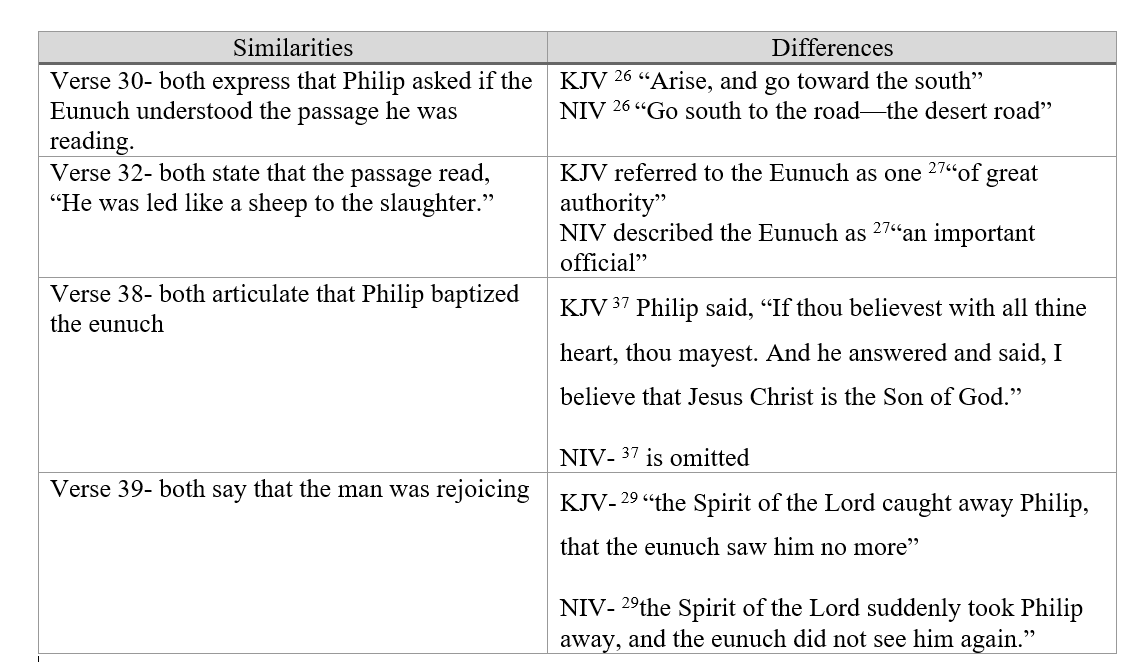
However, this is not a paper that seeks to deliberate what translation of the Bible one should or should not utilize. This is not a debate that I feel called to pursue, so reflecting on what may be altered or omitted is a concept that I will simply leave here for your own reflection. Which leaves us to the concept that I do desire to consider, understanding the encounter expressed in Acts 8:26-29.
The account of Philip and the Ethiopian Eunuch demonstrate that obediently responding to God’s call leads to transformative spiritual encounters, where both the messenger and the recipient experience the blessings of faith, understanding, and redemption, even when the journey requires sacrifice and trust in God’s guidance. In this event an angel of the Lord gave instruction to Philip to go and minister to an Ethiopian Eunuch who was attempting to read the Word. Ultimately, due to the obedience of both men, the Eunuch was baptized by Philip, continuing on his journey in praise as he rejoiced in the Lord, and Philip was taken away by the Holy Spirit. Due to his prompt obedience to travel towards Jerusalem the Eunuch was blessed with knowledge through teaching that led to belief and baptism, which remained strong even in the absence of his teacher.
So, what do I feel is expressed in this portion of Scripture? In Acts 8:26-39, obedience, and submission to God’s call is displayed. Despite having just finished ministering in Samaria, Philip is called to travel to a desolate place, where the Lord desires to use him in ministering to a eunuch. He does not murmur about being exhausted, nor does he complain about the distance ahead, he merely gets up and goes. Upon arrival, Philip overhears the educated eunuch reading a passage from Isaiah aloud and promptly runs alongside his chariot. Without wasting any time, he asks the eunuch if he understands it, acting as a servant of God, he recognizes that the Lord could utilize him to communicate the truthfulness of the Word.
In this, we are given a powerful example of faithful obedience despite the journey being one that was not expected. It is truly a display of how great an outcome is when we submit to God’s call. Despite having just finished ministering in Samaria, Philip is called to travel to a desolate place, where the Lord desires to use him in ministering to an Ethiopian Eunuch. He does not murmur about being exhausted, nor does he complain about the distance ahead, he merely gets up and goes. Upon arrival, Philip overhears an educated eunuch reading a passage from Isaiah aloud and promptly runs alongside his chariot. Without wasting any time, he asks the eunuch if he understands it, acting as a servant of God. Philip did not approach this man out of curiosity, but because he recognized that the Lord desired to utilize him to communicate the truthfulness of the Word.
In his willingness and desire to learn the eunuch expresses to Philip that his ability to understand would require that another teach him and thus, he invites Philip to join him on his journey. Again, as an obedient servant of the Lord, Philip climbs aboard the chariot and begins to teach. The eunuch hears and believes in the Word. As they continue along the journey and approach a body of water, the eunuch asks Philip what is to prohibit him from being baptized and the two men then leave the chariot and Philip baptizes him. It is after the baptism that Philip is taken away, as the Holy Spirit calls him forth to another ministry. In joy the eunuch continues his journey home, a born-again man, whom the Lord could use to further His Kingdom. In this portion of the Bible, we see that when the Lord calls, one must obey in order to allow His Word to reach all the nations. It is in such obedience that blessings appear, the heart rejoices, and lives are changed eternally.
This passage is a story of redemption, a man once lost in need of a Savior, yet also full of wonder and desire, thus, he accepts the ministry presented by Philip and receives salvation through Christ. It is evident that the eunuch was seeking to know more about God, he was yearning for the truth about the Son who was to bring healing and redemption to the world. His curiosity is in part disclosed through the passage he was studying in Isaiah which spoke of the coming of the Savior. Through the hearing and understanding of the Word, the eunuch was redeemed by the grace of God, he was baptized, and freed of his sins, because of Christs’ redemptive blood.
Throughout Scripture, it is evident that people are to heed to the call of the Lord. According to the Word, all are called to go into the world and preach the gospel of Christ, making disciples of all nations (Matthew 28:19). As a sacrifice, some were told to go, leave their earthly possessions behind, and tell the world of the Holy Savior. The disciples were instructed to sell their belongings, therefore, they conformed and abandoned all they had, to follow Christ (Matthew 19:21). It is in this that we see how Philip’s obedience which led to the eunuchs’ salvation fits into the principles of the Bible. Through the sacrifice of rest and a willingness to journey to reach the eunuch, Philip obeyed God’s call, to bring salvation to a lost man.
Philip did not question his call, embodying the same unwavering obedience that Jesus Christ demonstrated when He accepted His role as the living sacrifice for humanity’s sins. Philip’s willingness to follow God’s direction and guide the Ethiopian eunuch toward a deeper understanding and relationship with the Lord is a clear manifestation of Christ’s character within him. Just as Jesus was willing to go to any length—even to the cross—to save those lost in sin, Philip’s actions mirror this sacrificial love. Jesus chose the path of redemption, not out of obligation, but out of pure love, declaring that He would have endured it even for a single soul, as illustrated by the parable of the shepherd who leaves ninety-nine sheep to seek the one that is lost (Luke 15:3-7). Similarly, Philip, like the compassionate shepherd, prioritized reaching the one who was spiritually searching, demonstrating that what was truly needed was an encounter with the Lord. This passage not only highlights Philip’s faithful obedience but also reveals a profound reflection of Christ’s selfless love and redemptive purpose at work in him. Through Philip’s actions, we see the essence of Christ’s mission: to seek, save, and transform the life of even one who is lost, affirming that each soul is precious in God’s sight.
As believers in the Lord, we have a responsibility to obey His call. When the Lord asks us to go to perform His work, we should listen, without hesitation, just like Philip, we should act. According to the Bible passage, Philip was directed by an angel and called to witness to the Ethiopian and he simply got up and went, without question, he did not offer a spirit of reluctance, there were no childish temper tantrums, just pure obedience. Consequently, it is unquestioned subservience that the Lord seeks and desires of believers to spread His gospel unto all the world (Mark 16:15). Throughout Scripture, the Word describes obedience as a duty of followers of Christ. When one calls Him Lord, He asks why they call Him Lord, if they are not going to listen to His call (Luke 6:46), this is a question to consider. If a person truly knows the Savior, their actions should reveal it as they are dutiful to His commands; to love Him, is to comply with His instructions (John 14:15). When contemplating the character that Philip displayed, one should consider that he chose to minister to an Ethiopian, a person that was not a Jew, which was not a typical custom. According to the Word, we are to love our neighbors (Matthew 22:39), yet this type of love is not always shown to those who differ from the person called to minister. Philip showed that despite the eunuch being of a different nationality, he was going to share the gospel and show Christs’ love, knowing that God desires a relationship with all people. God’s love is unconditional; therefore, the love we show should be as such; unconditional love is a characteristic that reveals that the Spirit lives within us.
Additionally, the eunuch displayed a desire to learn from and understand the Word. In his willingness to permit Philip to teach him, the eunuch revealed a humble spirit. Humility is a characteristic of a Godly person seeking spiritual growth. Christians are called to humble themselves and are told that in their meekness they will be offered grace (James 4:6), thus, the eunuch, though not yet saved, was eager to know the truth, and already displayed a Godly character. From this, one should remember that the Lord will lift those who humble themselves (James 4:10).
In considering the example we are given, it is essential that we reflect on the true aim we as Christians aspire to reach in this journey of life. In ministering to the lost one should not seek the praise of man, for gaining fame does not reveal God’s love, but a desire to be noticed. Ministering to the lost should be done as one that genuinely seeks to be a vessel utilized to free others from the bondage of sin, allowing the Spirit to work and speak through him or her. Therefore, as Christians, the goal to be accomplished is to reach as many people as possible through spreading the gospel. The Great Commission is essential to the Christian faith. Therefore, if believers do not tell others of Christs’ love, His sacrifice becomes valueless and our confession of faith, useless. Consequently, we must seek to hear the Lord, heed to His calling, and reveal the character of Christ in our daily walk, allowing others to observe the unconditional love of the Father in our actions.
One important aspect of faithfully following God is learning to discern His voice among the many influences we encounter each day. Humans all have inner voices; the question they must ask is who is speaking? When one feels led to take some sort of action, it is essential to recognize when it is the Holy Spirit who is directing their steps. Discerning the call of the Lord and what actions He is requesting will permit them to further the growth of His Kingdom. Thus, considering Philip, he was able to recognize the call of the Lord and move forward in action. If we, as believers, are to accomplish His plans, we must listen and weigh what we hear against the Word of God. We can remain confident that it is the guidance of our Lord that is urging our actions if the instruction aligns with the Word. According to Scripture, when the Lord calls His sheep, He goes before them, leading the way, He will prepare the path which He calls His children to take (John 10:3-5). Therefore, we can rest assured, that if we are led by the Father, He will provide and pave the way for us, through Him, to accomplish all that He calls us too. In this way, discerning God’s voice and responding in faith allows us to walk in His purpose and witness His faithfulness in our lives.
In summary, the Scripture about Philip and the Ethiopian eunuch in Acts 8:26-39 serves as a compelling reminder of the transformative power of obedience, humility, and discernment in the Christian walk. Philip’s immediate response to God’s call, coupled with the eunuch’s openness to learning, demonstrates that when believers submit to the Lord’s guidance, extraordinary encounters and lasting spiritual change can occur. This passage encourages us to listen attentively for God’s direction, to act without hesitation, and to embody Christlike love in all our interactions—knowing that through our faithful service, God’s message of redemption can reach even the most unlikely hearts. Ultimately, by following the examples set before us, we participate in God’s ongoing work, helping to fulfill the Great Commission and revealing His unconditional love to the world.
Discernment on who is calling us to act is so important here. It’s hard to know sometimes.